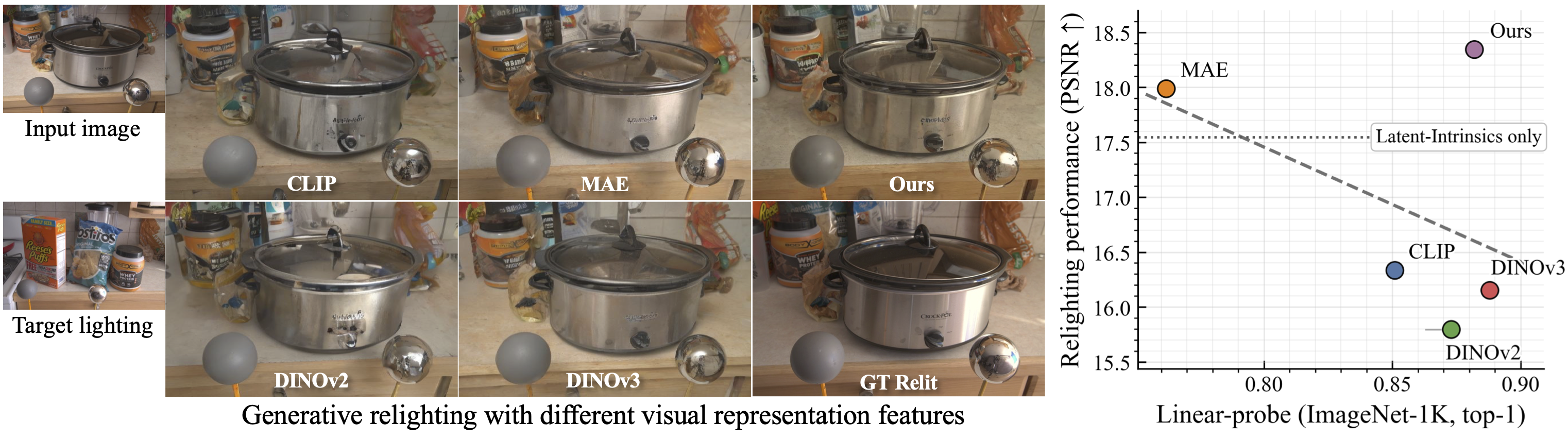
Image-to-image relighting requires representations that disentangle scene properties from illumination. Recent methods rely on latent intrinsic representations but remain under-constrained and often fail on challenging materials such as metal and glass. A natural hypothesis is that stronger pretrained visual priors should resolve these failures. We find the opposite: features from top-performing semantic encoders often degrade relighting quality, revealing a fundamental trade-off between semantic abstraction and photometric fidelity. We study this trade-off and introduce Augmented Latent Intrinsics (ALI), which balances semantic context and dense photometric structure by fusing features from a pixel-aligned visual encoder into a latent-intrinsic framework, together with a self-supervised refinement strategy to mitigate the scarcity of paired real-world data. Trained only on unlabeled real-world image pairs and paired with a dense, pixel-aligned visual prior, ALI achieves strong improvements in relighting, with the largest gains on complex, specular materials.
Here we show interactive relighting results driven by different visual features within our Augmented Latent Intrinsics framework. The G-buffer–based method RGBX is included as a reference. Pick a scene to compare, and use Compare two for a draggable side-by-side of any pair. The bypass decoder is disabled for the best comparison.